Private jet airports in the Netherlands
Six fields that take business jets, what each one is good for, and how to pick.
Read this guide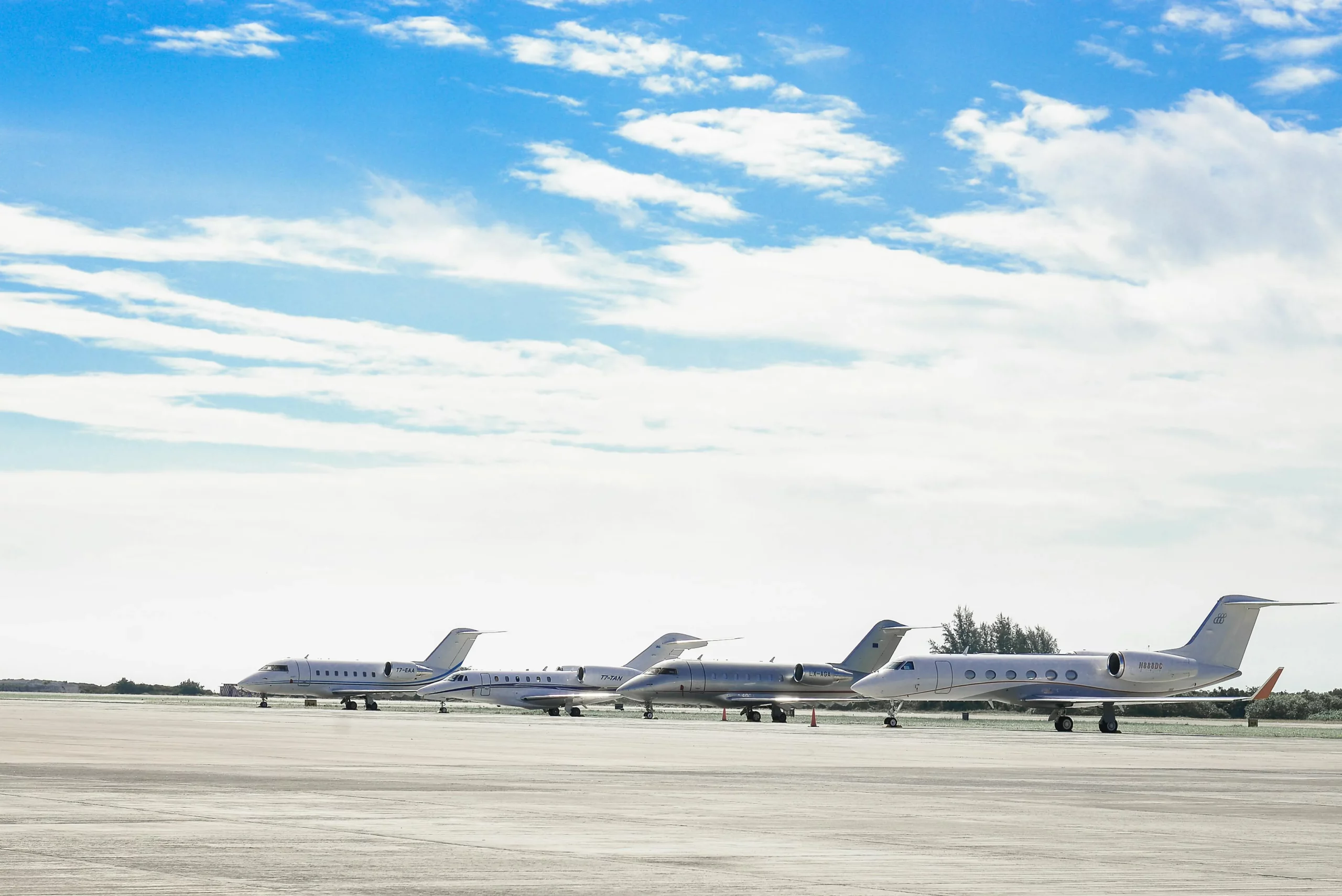
Guide
An FBO, or fixed-base operator, is the private terminal a charter flight uses instead of the main airport building. You drive to its door, identity and border checks happen inside, and you walk or are driven to the aircraft. Fifteen to twenty minutes before departure is normal.
Every airport that handles business aviation has at least one FBO, and most passengers who have never chartered have never noticed it. It sits away from the main terminal, usually on the general-aviation side of the field, with its own road access, its own car park and its own apron. The point of it is that the airport experience — queues, gates, boarding groups — does not happen.
The name is an accident of history. In the 1920s, American airfields distinguished companies with a fixed base from barnstormers who moved on, and the label stuck. Functionally, an FBO today is the handling agent for private aircraft: it fuels and parks them, looks after their crews, and receives and dispatches their passengers.
The sequence below is typical for a European departure. Times are indicative; the operator sets the exact arrival time for your flight and it depends on the destination.
| When | What happens |
|---|---|
| −20 min | You arrive by car at the FBO. Luggage is taken from the car by staff; it goes directly to the aircraft. |
| −18 min | Identity check against the passenger manifest the operator filed earlier. For a flight leaving the Schengen area, passport control here. |
| −15 min | Security screening appropriate to the flight. Lounge, coffee, a few minutes. |
| −8 min | Crew collect you. You walk, or are driven, across the apron to the aircraft. |
| −5 min | Boarding. Safety briefing from the crew. |
| 0 | Doors close. Taxi and departure. |
Arrival is the mirror image and faster still: the aircraft parks at the FBO's apron, you step off, luggage follows, and immigration for an inbound international flight happens in the building. On a domestic or intra-Schengen arrival you can be in the car within five minutes of the door opening.
Schiphol's General Aviation Terminal is on the east side of the airport, separate from the passenger terminals, with its own access road. It handles the bulk of the country's business aviation and is the default for short-notice flights because so many aircraft are already there. Rotterdam The Hague is served by Jet Aviation, with a single runway and a much shorter path from car to cabin. The Schiphol-or-Rotterdam question is in practice a question about which of these two buildings you would rather walk through.
The FBO is paid for through a handling fee, charged per movement and set by the FBO and the airport. It sits in an all-in quote alongside landing fees and parking, and it is higher at a major hub than at a regional field — one of several reasons a smaller airport can be cheaper for the same aircraft. It is a normal cost of the trip and it should be visible in the quote. Our cost guide lists it with the other items that sit on top of the hourly rate.
Bring the passport or ID card used on the manifest — the name must match. Bring your luggage in whatever form; there is no bag-drop and no size gauge, only the aircraft's own limits. Do not arrive an hour early; there is nothing to do with the hour and the crew will not be ready. Do not worry about finding the aircraft, the gate or the right door. Someone walks you to all of them.
The FBO is the part of a charter that most surprises first-time passengers, because it is where the time saving actually happens. The flight is the same length in a chartered jet as it would be in the front of an airliner. The two hours you do not spend in a terminal are the product. Request a quote and the FBO details for your departure come with the confirmation.
Questions
Fixed-base operator. The term dates from early American aviation, when a company with a permanent base at an airfield was distinguished from itinerant operators. Today it means the business that handles private and business aircraft at an airport: fuel, parking, passenger and crew services.
Identity and, where applicable, customs and immigration checks are carried out at the FBO. Screening procedures for private flights differ from scheduled airline screening and vary by airport and by destination — the operator will tell you what applies to your flight. It is quick, but it is not nothing.
Schiphol has a dedicated General Aviation Terminal on the east side of the airport, away from the passenger terminals. Rotterdam The Hague is served by Jet Aviation. Our guide to Dutch private jet airports covers the other fields.
The handling fee that pays for it is one of the line items in an all-in quote, alongside landing and parking. It varies by airport and is higher at large hubs. It should be visible in the quote rather than appear afterwards.
Read also
Six fields that take business jets, what each one is good for, and how to pick.
Read this guideThe airborne difference is under four minutes. Everything that matters happens on the ground.
Read this guideFirst charter?
The FBO, the timing and what to bring come with the confirmation. Nothing is left to guess.
Last updated by the Mondial Jets team.